
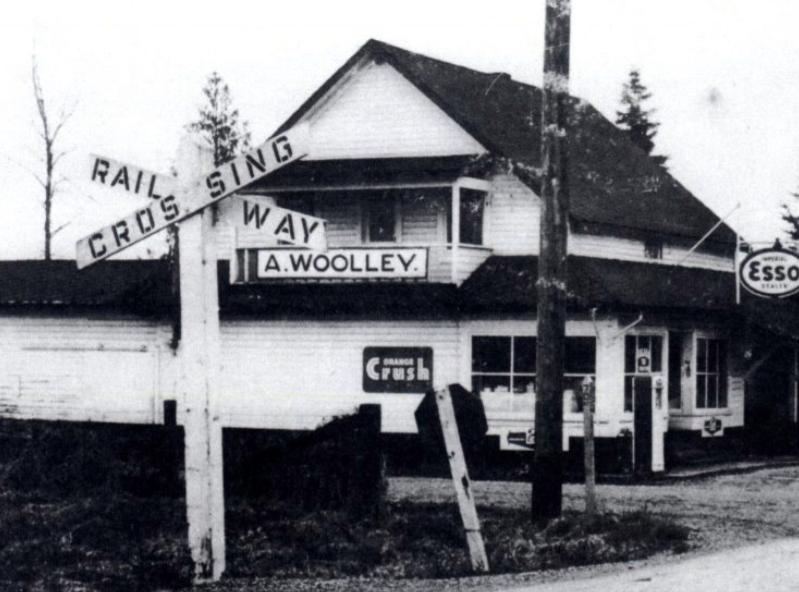
My parents, Art and Doris Woolley, purchased the Sperling General Store and Post Office in 1945, the year I was born. Mom was the postmaster and they both operated the store, Mom taking orders by phone, then Dad delivering groceries and hardware throughout north Langley until the 401 Freeway forced the closure of the store in 1962.
Dad had driven the delivery truck for Harry Berry in the 1930’s thru to 1945. Langley’s Heritage – A Listing of Heritage Resources published in 1995 notes that: “Much of the surrounding community survived the Depression due to Berry’s generous extension of credit.” Dad certainly followed Mr. Berry’s generous example and extended credit to local farmers and fishermen hoping to settle the account at the end of each season. Although many customers were not able to clear their debt by the time the store closed, one family kept a record of their account and paid in full many years later.
The mail would arrive in heavy sealed canvas bags which were thrown onto the platform of the Sperling Station from the interurban tram. Sperling was a flag station which meant the tram nor the BC Electric Train would stop at the station unless a red flag was placed on the platform close to the tracks to indicate that passengers or freight were waiting.
Mom would pick up the mail bags and take them to a little alcove in the northeast corner of the store, known as the “Sperling Station Post Office”, to sort and hold the mail in small wooden slots for every family in our community. She used a very tall desk that I could walk under without hitting my head. That desk along with other artifacts were donated to the Centennial Museum in Fort Langley. “The Sperling Station Post Office was closed on November 30, 1948, just about two years before the last interurban travelled the line on September 30, 1950.” An excerpt submitted by Mr. N.A. Sherritt from The Place Between.
The store came with an ESSO Dealership with one old original gas pump that was operated by hand. A customer would pull in and request the number of gallons they wanted and share some local news while watching Dad go through the operation. The pump handle was vertical, and when forced back and forth, pumped the gas up into the glass cylinder on top which could measure from one to ten gallons each cycle. The pump was located very close to the building and the motor oil, kerosene and barrels of other flammable products were stored against the wall just outside our living room under an open porch-like structure. We could look out the front window to see someone dropping by for gas or groceries.
Barrels would have taps or valves placed in the top then were tipped onto a built-in bench. The motor oil was dispensed into one quart glass bottles for resale and the kerosene was measured and poured into the customer’s container. No waste and no disposable containers. However, the wood surface supporting the barrels was soaked and preserved with the oils, giving it a unique color and odor.
A replacement “modern” gas pump was located at the northwest corner of the store, still very close to the main building and the adjacent lane.
As people entered the store, the door would trigger a bell to announce their arrival. The lack of insulation in the building facilitated hearing the bell from any location. Handy for the person tending the store, but annoying for a teen trying to sleep in. The door had a thumb latch and handle and was covered with decals advertising tea, coffee and pop. A window in the top third of the door would often shake loose and rattle and the aging tongue and groove wood floor would complain with the first step taken inside. The smell of the oiled floor and the products was confirmation of the age of the building and its current use.
The National Cash Register was very ornate with cast and polished scrolls on every surface and it had a very distinctive “Ka-Ching” when the cash drawer was opened. While I was cleaning the old till years after the store closed I realized that the cash drawer was not opening smoothly or roll all the way out. When I removed the drawer I found a crumpled piece of paper caught in the rollers. It was an Old Age Pensioners cheque that had been cashed for Mr. Cripps. I think Mom was serious when she said, “Why Revenue Canada will be wondering why Mr. Cripps never cashed his cheque.” She mailed it in explaining the many years of delay and she actually received a response along with a cheque for the full amount of $12.85. Our grandchildren are delighted when the old cash drawer rolls out with a “Ka-Ching”.
The candlestick phone was a classic and was connected to a “party line” used by a number of neighbors. Each phone on the party line had a unique ring controlled by the BC Telephone operator. When we heard a short then long ring, we knew the Dahls had received a call. If we picked up our phone, gently, we could listen in. The store was two short rings and the neighbors would know who the call was for, particularly on order day! Customers would phone with a list and be ready to alter their requests based on what meat, fresh fruit or dairy products were available. There would be weeks with blocks of cheddar cheese or an aged side of beef or pork from Mr. Datwiler’s “meat market on wheels.” Dad cut the meat on a special board placed on top of the freezer chest.
Delivery day was Saturday. Orders were placed in cardboard boxes with family names written with a marker pen and of course the “live stock” as Dad called it, went in last. (Meat, milk, butter, etc.) I got to go along sometimes. Dad carried the orders on his shoulder right to the kitchen of each home. It seemed to me that he was checking in to see how the families or the old bachelors were doing this week. Over the years he found an elderly man that passed away in his bed, and another that took his own life with his hunting rifle. Little kids would greet him with excitement as though he was Santa Claus, however they were actually hoping that their mother had ordered a special treat this week, perhaps because they heard their dad or uncle say the fishing had been good this week.
Memories by Marv Woolley, September, 2016
