
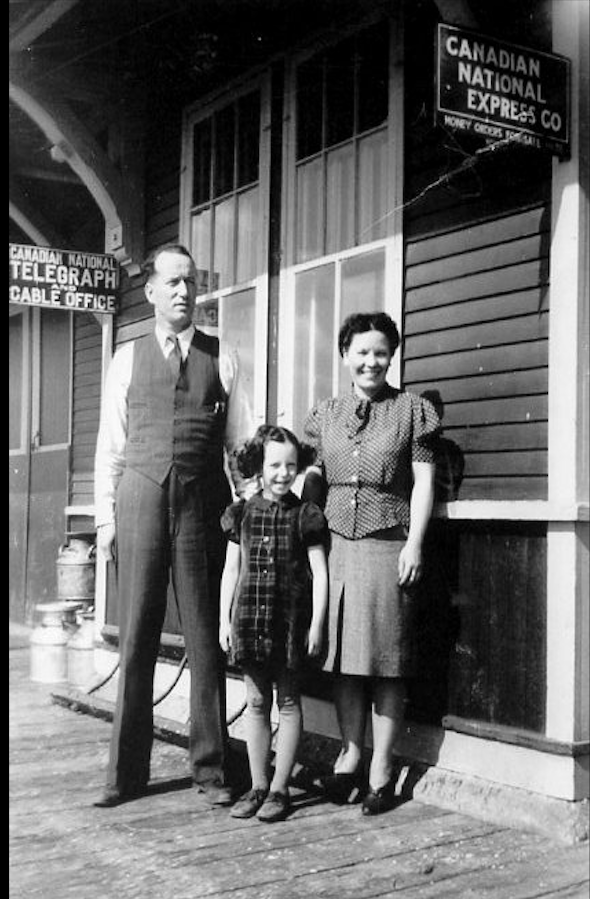
Not too many people practised Morse Code using their knife & fork at the dinner table, but Diane Simpson is one of them. Her father, Murray Williams, was a CN Station Agent who wanted his two children to know the basics of the code. Murray spent the last three years of his career (until 1968) at the Fort Langley CN Station with his wife Florence; today the station is the jewel of the Langley Heritage Society. Diane grew up in CN stations on the prairies and in Alberta, and has been one of our society’s treasured volunteers. She has often been asked about the role of the station agent. Here’s what she told us in her story Tales From the Station House: The Williams Family on the Rails!
The most obvious tasks of the agent are, of course, selling tickets and helping people plan their trips. Receiving, recording, billing and loading the freight on the train were just as essential, seeing that the freight was delivered or picked up, and ordering freight cars for mills and elevators.
In earlier times and at different stations, sending telegrams around the world was also part of a day, informing friends and family of births, deaths, marriages and family news. It was very hard to hear on the telephones in the 1940s and 50s, and also very expensive, thus most immediate news went by telegram. When we lived in various small towns in Saskatchewan, my father usually delivered these around the village at noon or after work, but occasionally my brother or I delivered one on our bicycle. The relaying and receiving of train orders via telegraph from the Division Dispatcher was of prime importance for an Agent on the main line — extremely important during the war for the movement of troops and supplies. Relaying orders from the Regional Dispatcher to an engineer was done by changing the arms on the signal pole to “slow” position. When the train slowed down the Agent would position himself on the platform and hand the hoop with the message fastened on it to the Engineer who would put his arm through the hoop, detach the message and throw the hoop out once they were past the station.
Locally, there was the responsibility for for seeing that the freight and groceries arriving daily were stowed on the dray wagon, originally pulled by a team of horses and later by a tractor. Goods were delivered to all the businesses in the village by the Drayman, and the freight charges were collected monthly. Money from the town bank and the local mail were also sent on the secured mail coach. The station was a hub of activity in a small town. I am not aware of a robbery from a CNR mail coach in those years. There were no Billy Miner-type scallywags in Saskatchewan and Alberta! One hot summer day, the freight wagon wa piled high with 35 dozen eggs when a sudden prairie dust devil caught it, and blew it quietly right off the end of the platform. The thought of cleaning up the mess that would soon smell awful made dad pretty angry, and I am sure the air turned blue.
Many workers were necessary for the operation of the railroad. The Engineer, Brakemen, Conductor and Station Agent were obvious to the passengers, but the Section Foreman and his men who kept the track and rail bed in good repair, the Drayman who loaded the freight on his large wagon, the special rail gangs; the B&B Gang (Buildings & Bridges) who did station repairs and painting, and the Switchmen who ensured the trains went on the correct tracks were mostly under the direction of the Roadmaster. These are some of the ones I can recall, but there were many others, depending on the size of the town and the businesses, and whether or not it was a divisional point.
Chores in a station without electricity, plumbing, furnace or any convenience were allotted to everyone, but Mom and Dad did the most. Taking out the slop pail from under the sink and the honey wagon from upstairs were likely the most odious(in every sense of the word). Dad looked after all those chores while we were young, as well as the filling of the coal oil lamps; Mom and I cleaned glass chimneys, while Dad kept the mantles on the gas lamp changed, lit and looked after. My brother Brian chopped kindling for the kitchen stove and did yard chores, and I pumped drinking water, washed dishes and cleaned upstairs on Saturdays.
Getting water for washing clothes and bathing was a delicate matter at the last station we lived in. (The water from the well in our yard was so hard that soap would not dissolve.) Mom made a good bread pudding, the best “jewell pudding” topped with meringue and dabs of raspberry jam. George, the Drayman, was fond of bread pudding and kindly brought us a couple of barrels of soft water from the creamery for washing clothes and bathing in exchange for that pudding. George was a bit touchy and his feelings had to be considered carefully. Mom also, not happily, sometimes swept the freight shed clean and attended to the annual cleaning of the outdoor convenience, as well as looking after us and our home.
Sunday afternoons my brother and I searched along the tracks for the hoops that were tossed along the side of the track after the messages had been removed by the Engineer. Everyone in the family had their jobs to do around the station.
Diane Simpson, Fort Langley

Diane and brother Brian at Mawer, Saskatchewan
