
Maurice Guibord, Executive Director of Société historique francophone de la Colombie-Britannique has done extensive research into Francophone history in British Columbia. The excerpt below is from his presentation to the Langley Heritage Society in spring 2024.
 “The beginnings of Francophones in the area that became Langley go back to the beginnings of colonization. For the continental fur trade to be fully controlled, the HBC established forts throughout the territory, staffed by Kanakas (Hawaiians), Orkneymen, Englishmen, and a majority of French-speaking Canadiens (the term then used for French Canadians), Métis and First Nations men from Lower Canada. In 2010, historian Bruce Watson researched and published his three-volume compendium Lives lived west of the divide: A Biographical Dictionary of Fur Traders working west of the Rockies 1793-1858, which clearly indicates that over 60% of the fur trade employees on the Pacific coast were Francophones. While the Chief Factors were Anglophones, they could speak in French with their employees, and the fur trade itself was often conducted in French, so the Kanaka and English employees learned the language, along with the Chinook jargon, which contained numerous derivatives or whole words from French and English. Fort Vancouver, which is today’s Vancouver WA, was the hub of the HBC activities in the Oregon Territory, so there again, we saw a preponderance of Francophones, the descendants of which are still very prevalent in the Pacific Northwest, in villages bearing French names as well as in Native American reservations.
In the winter of 1824, James McMillan headed up an HBC survey party from Fort George (present-day Astoria, Oregon), to survey the mouth of the Fraser River and to assess it for navigability, settlement potential and agricultural suitability. As well, he was to find a suitable site for a new Hudson’s Bay Company fort (the eventual Fort Langley).
A complement of 41 men travelled the distance, mostly by canoe. They included 36 Voyageurs (of which 21 were Canadiens), 6 Iroquois and 4 Abénakis (all French speakers), 6 Kanakas, 1 Englishman, 1 American and the Scottish-born McMillan, as well as 3 Indigenous interpreters. Once at Semiahmoo bay, the party headed up the Nicomekl River. They had to portage over to the Salmon River before reaching the Fraser, and this is where the expedition traversed part of what is now Langley. The expedition then sailed up the Fraser and went as far as Hatzic Slough before returning to Fort George, Oregon. Part of this expedition and portage will be the subject of a reenactment and commemoration in Langley in December 2024, 200 years to the day after it took place.
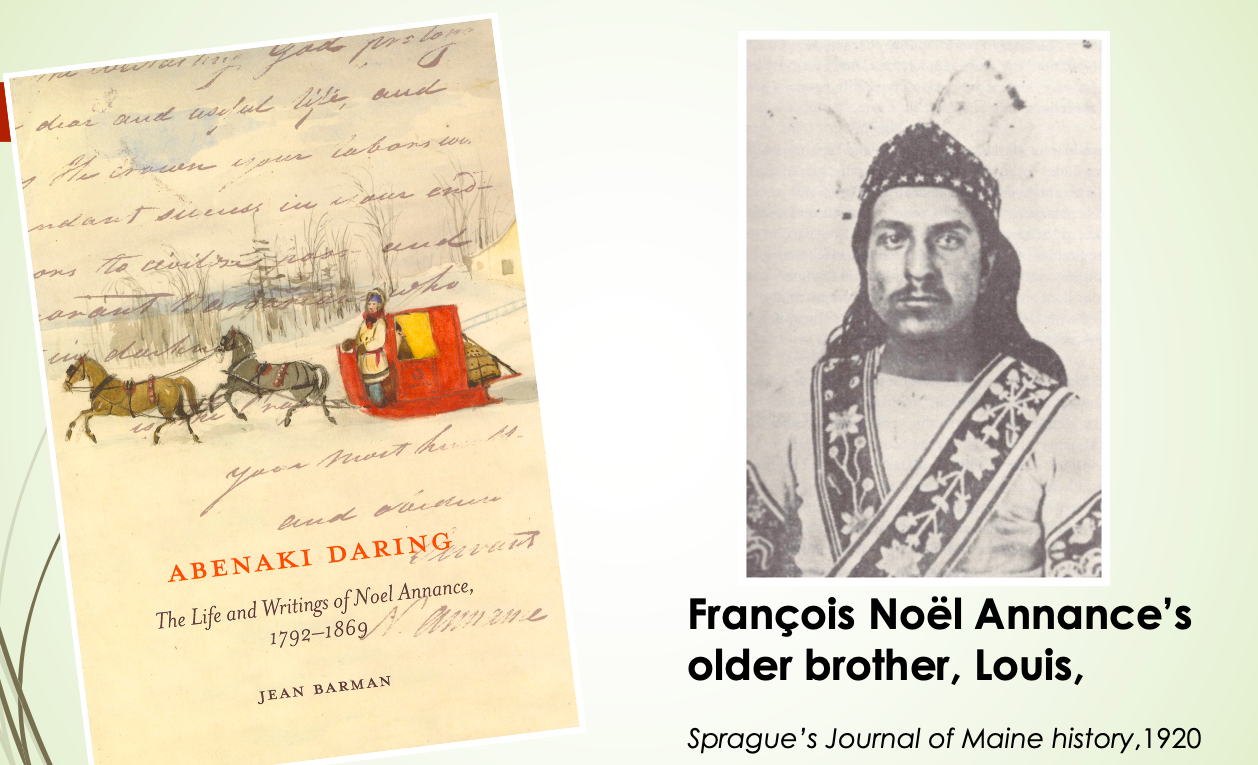
So this is the first incursion of Francophones into what would become Langley. The most famous Francophone there was François Noël Annance, an Abénaki well educated by the religious in Lower Canada and who would become a respected member of HBC staff, though his nativeness prevented him from advancing beyond the position of clerk. You will have seen a site that bears his name, the industrial island under the bridge leading to the Vancouver airport, Annacis Island, the name of which is corrupted from the original Annance’s Island.”
