

Landscapes, streets and buildings are often named to honour a person of distinction, but sometimes the story of why that happens is fuzzy. Bonnie Hartup is a volunteer with the Langley Heritage Society who did a deep dive into the man that Bedford Channel is named after.
Have you wondered for whom Bedford Channel is named for? Langley’s archives tell us it was for Charles John Riland Bedford, born in August 1828 at Sutton Coldfield, Warwickshire. His family held position in Warwickshire, many of his relatives, including his father and brother, were clergy in the parish of Holy Trinity Warwickshire.
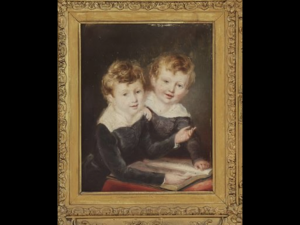
Charles Bedford (born 1828) and sibling
His father sent him to Westminster private school ( 1842-1846) and then in 1849 purchased his entry officer position in the Warwickshire Militia as an Ensign. He resigned in 1850, rejoined in 1852, and was promoted to Captain. Charles spent some time with the 92 Gordon Highlanders in Scotland but resigned that position in 1855. By 1856 he was asking various people in military and government for letters of recommendation.
On November 5 1858 he sailed from London to Victoria via New York, to Aspinall, train to Panama, ship to San Francisco, then to Esquimalt and arrived in Victoria on Christmas Day 1858. During his travels he shared time, meals, and hotels with other colonial notables: Colonel Richard Moody, Robert Burnaby, Thomas Bushby, and Reverend Crickmer. While in Panama, rats ate his boots.
Bedford met Governor James Douglas and was appointed (Jan 19, 1859) Magistrate to Fort Langley, where thousands of miners were waiting for ice on the Fraser River to melt before heading to the gold fields. The mostly American miners were causing chaos, and Charles Bedford was sent – with two police constables – to bring order.
At this time he also put in bids to buy lots at Port Douglas (at top end of Harrison Lake). He sent numerous letters to Governor Douglas and the Acting Colonial Secretary, including requests for $200 to build a courthouse; funds for the salaries of constables; permission to buy firewood; letters of complaint about the constables and letters of complaint about the revenue officer. He seemed to have a deep distrust for the Revenue Officer Bevis, complaining that the officer didn’t catch smugglers because he didn’t inspect cargo nor watch the river at night. He also thought Mr Bevis was indebted to people who bought licenses for travel.
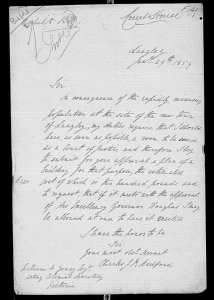
Bedford letter requests a building for a Court of Justice at Fort Langley. (BC Archives)
Bedford’s resignation after just two months came when he learned that Mr Bevis had more authority, and a higher salary. Bedford wanted final authority. He went on to lease the Hudson Bay Langley Farm in March 1859 and a Captain Grant took exception to a horse that he bought from Bedford because it was lame. By July 1860 the company repossessed the farm because Charles did not produce annual accounts as required by the rental agreement. Some accounts indicate he had run the farm into the ground.
Charles returned to England and lived at several addresses with no visible job but was living on his “own accounts”, and in December 1865 he declared bankruptcy. While visiting Magistrate Garnett and his family in 1871, Charles, age 42, married the daughter of the magistrate, Emily, 32 years. They had four surviving children. In 1882 he declared bankruptcy again. Censuses for 1891 and 1911 show Charles is not living with his family but staying with friends and with his brother. Charles died in 1910 at Upton-Upon-Servern, Worchestershire .
Who decided the channel in Fort Langley would be called Bedford Channel? He didn’t seem to endear himself with Governor Douglas. The many letters he wrote were well written but often negative. He jumped from position to position with two different military groups, in his life in BC, and in his marriage. He lived in BC for only 2 years.
I noticed in a letter that he wrote to Governor Douglas about a trip to explore Pitt River and Pitt Lake, that he drew a small map of the area. I wonder if he drew a map of Fort Langley and added “ Bedford Channel” as the name on the map? Or did his friends from the ships, Colonel Moody, Robert Burnaby or Arthur Bushby, have some influence on the naming of the channel? He was here so briefly but didn’t make any note worthy contribution.
(Bonnie Hartup is a volunteer with the Langley Heritage Society’s CNR Station)
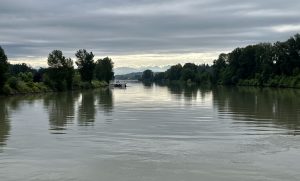
Bedford Channel looking east (Forsythe photo)
